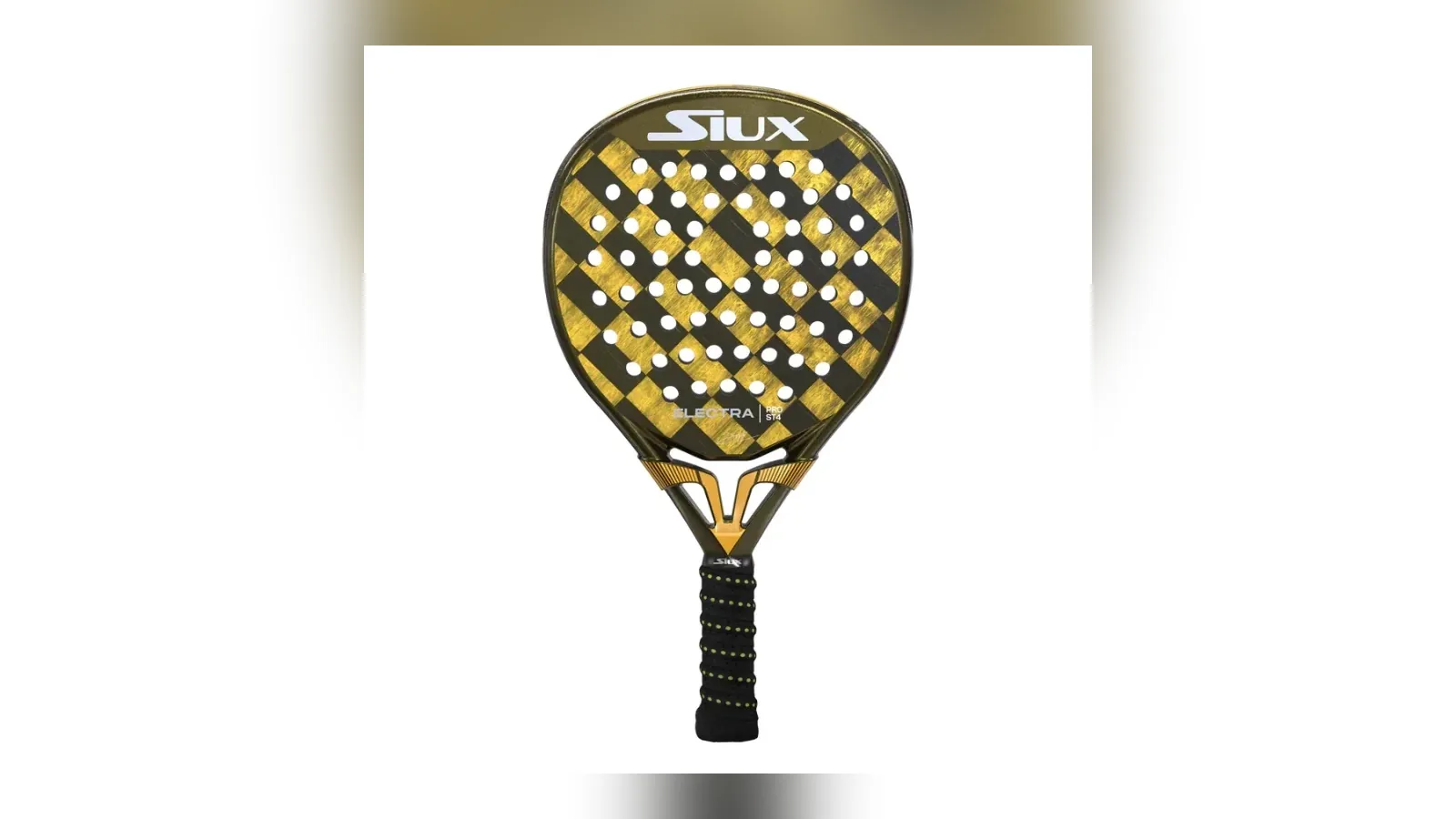
Franco Stupaczuk's rackets rarely arrive quietly, and the Siux Electra ST4 Pro Stupa is no exception. This latest edition of Siux's flagship hybrid keeps the teardrop shape that made the line famous, but reworks the core, the drilling and the balance. The result is a racket built for players who already strike the ball cleanly and want to hit harder without losing their shape.
Design and materials
Siux built its reputation on Stupaczuk's back, and the Electra series is the clearest evidence of that relationship. The ST4 is now the previous generation model, since Siux has since released an ST5, but that does not make it a lesser racket. It remains a serious, well specified hybrid aimed squarely at advanced players.
The shape sits between a diamond and a round head, which is the whole point of a hybrid design. You get more forgiveness than a pure diamond racket but noticeably more pop than a rounded control model. Siux paired this with a 15K carbon face over an EVA Hard core, giving the ST4 a medium hard touch that feels direct rather than plush.
Weight runs from 355g to 375g depending on the batch, and the balance point sits at around 26cm, which Siux classes as medium high. That places the ST4 firmly in attacking territory without tipping into the head heavy feel of a pure power racket. Swing it a few times and the weight distribution feels sensible rather than extreme.
What changed for ST4
What changed for this generation is more interesting than the headline numbers. Siux reinforced the heart of the racket with a double V shaped support, replacing the single horizontal reinforcement used previously, and altered the drilling pattern so the central zone around the sweet spot is left unperforated. The practical effect is a sweet spot that sits lower and more central than on the ST3, which some players will notice immediately if they are used to hitting higher on the face.
In hand, that lower sweet spot changes how the racket rewards contact. Strike centrally and the ball comes off with a crisp, controlled pop. Catch it fractionally high or off to the side and the response drops away quickly. This is not a racket that hides technical flaws, and players who mishit regularly may find it less forgiving than a true control model.
On court performance
The sandblasted finish on both faces is doing real work rather than just looking good. It bites into the ball on slice and topspin shots, which is noticeable on bandejas and viboras where extra rotation helps the ball die quickly on the far side of the net. Smashes carry real pace too, with the stiffer 15K carbon lay up giving a direct, uncushioned response at the point of contact.
At the net, the ST4 responds quickly. The compact swing profile and controlled weight let you react to fast exchanges without feeling rushed, and volleys carry enough pop to trouble opponents rather than simply blocking the ball back. From the baseline it holds depth well on drives, and the textured face helps generate the kind of heavy topspin that pushes opponents deep.
Is it better than the racket it replaced? Softer than the ST3 but firmer than the ST2, the ST4 sits in between the two in terms of feel, which Siux seems to have done deliberately to widen its appeal slightly without losing the attacking character the Electra name is built on.
Comfort and grip
Comfort is a mixed picture. The manageable weight and balanced mass distribution mean the racket does not feel tiring to swing over a long match, and the frame itself does a reasonable job of controlling vibration on centred hits. Off centre strikes are a different story. The stiffness that gives the ST4 its punch also means mishits transmit more shock through the hand and wrist than a softer, more flexible racket would. Players managing joint issues may want to test before committing.
One recurring criticism is the stock grip. Several independent reviewers have flagged it as slippery and awkwardly shaped, with a bulky central section and a small butt cap that some hands find unnatural. It is a strange weak point on a racket that gets so much else right, and the common advice is to replace it or add extra overgrip layers before the first session.
Siux also added a detachable wrist strap for this generation, a small but genuinely useful change that makes cleaning or replacing a worn strap far simpler than on rackets where it is stitched in permanently.
Durability and value
Durability has held up reasonably well in longer term use, according to owners who have put real hours on the racket, though a handful mention the finish marking with heavy use, which is common enough on textured carbon faces and not unique to Siux. Build quality otherwise feels consistent with what buyers expect from a signature model at this level.
Price is where the ST4 becomes harder to judge in isolation. As the previous generation in the Electra line, it now typically sells for less than the current ST5, and can be found at a genuine discount through UK and European retailers compared with its original launch price. For players who want the attacking character of the Electra family without paying flagship prices, that gap is worth exploring before assuming the newest model is the only option worth considering.
Set against rivals in the same bracket, the ST4 leans harder into attack than most control focused hybrids at a similar price. It trades some of the comfort and forgiveness you would get from a softer, more rounded racket for genuine pace on the smash and a face that rewards players who commit fully to their shots. That trade off will suit some players far more than others, and it is worth being honest about which camp you fall into before spending the money.