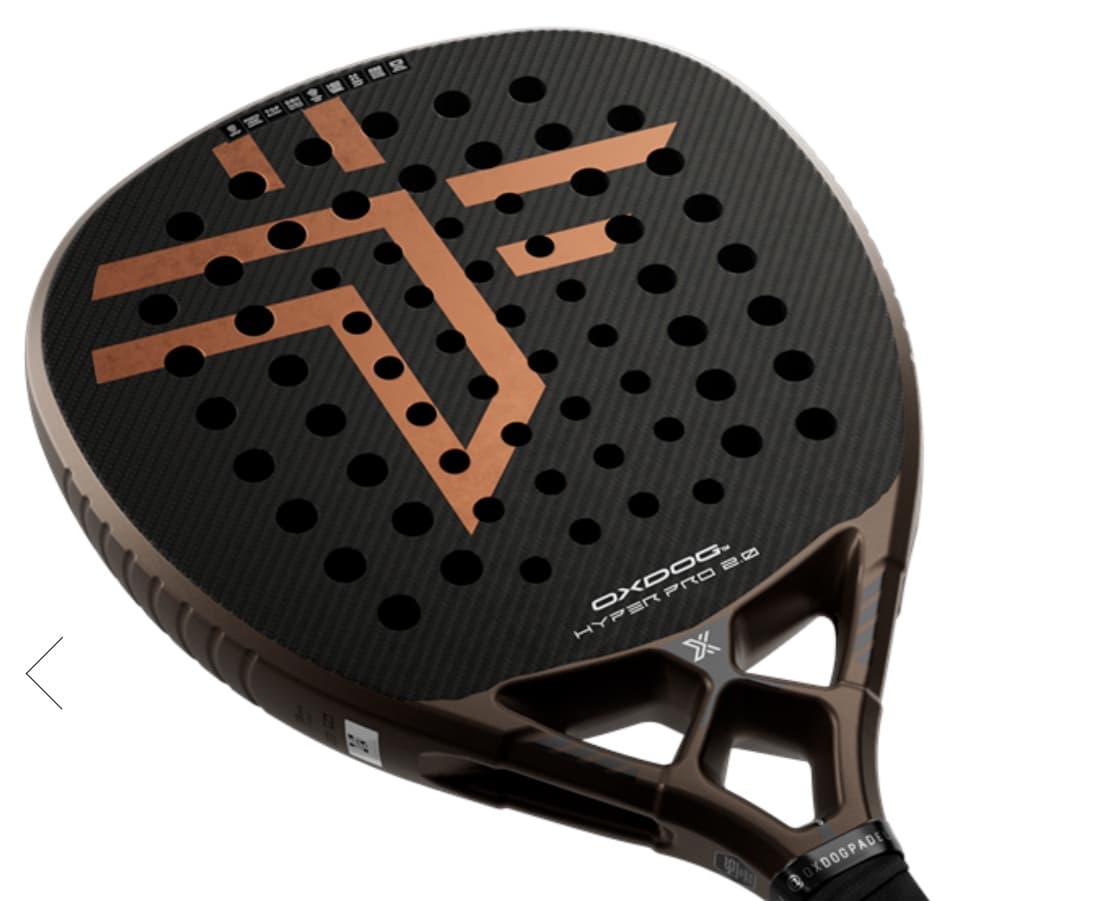
The Oxdog Hyper Pro 2.0 2026 sits at an interesting crossroads. It's built for players who like to finish points at the net, yet it refuses to punish anyone who hits slightly off-centre. The teardrop shape and head-leaning balance point towards attack. But the sweet spot is wide enough to keep the margin for error respectable. It's an ambitious brief, and mostly it delivers.
Oxdog has kept the Hyper 2.0 platform largely intact for this update. That's not a criticism. The Hyper Pro 2.0 sits in the middle of the range, above the more forgiving Hyper Tour X 2.0 and below the heavier Hyper Pro+ 2.0. That positioning matters. This isn't a racket for someone chasing outright pace above all else. It's for players who want to attack with intent but aren't prepared to give up control to get there. If you are looking for a light weight racket, consider the Head One Ultralight as an option.
Shape and feel
The frame keeps Oxdog's familiar teardrop mould. The sweet spot sits slightly above centre rather than dead in the middle. That positioning does two useful things. It adds depth to flat drives without much extra effort, and it gives volleys and bandejas more weight than the shape alone would suggest. Players moving up from a rounder, more beginner-friendly racket should find the transition manageable rather than jarring.
Balance leans towards the head, typical for a teardrop built with attacking play in mind. You feel it most in overheads. The racket seems to want to accelerate through the ball rather than needing to be muscled into it. That's a genuine strength. Smashes carry more sting than the racket's weight would suggest on paper, and there's a pleasing sense of the frame doing some of the work for you.
The trade-off shows up in quick exchanges at the net, as it does with most head-leaning frames. React late to a volley, or get caught mid-transition, and the extra mass towards the head asks a bit more of your wrist. Nothing about it feels unmanageable for an intermediate or advanced player. Beginners moving up too quickly, though, might notice the difference in a defensive scramble.
Surface, core and touch
Oxdog has stuck with a sandy-textured HES-Carbon face on the Pro version. That separates it from the smoother Tour and Match variants in the same range. In practice, that texture bites into the ball nicely on slice and top-spin shots. It also holds up well against balls that have gone slightly fluffy after a few sets. Grip on the outsole is consistent underfoot too, without feeling sticky or slow through direction changes.
Underneath the carbon sits an EVA Medium foam core. It's tuned firm enough to hold its shape under a smash, but not so hard that it turns every mistimed shot into a jolt through the arm. Contact feels direct rather than springy. Some players may notice the ball comes off a touch lower and slower than it would from a softer-cored racket. That fits with how Oxdog has positioned this model: control first, power on demand.
PowerRibs reinforcement sits behind the face to add torsional stability. Oxdog's DSH holes, its double-size perforation pattern, are there to help with spin and to keep the sweet spot forgiving even outside its core zone. Whether every player will consciously feel these technologies working is another matter. What matters more is the result, and the result is a frame that holds its line well under pressure without twisting awkwardly on scrappy contact.
Comfort and vibration
Oxdog's Vibradamp system runs through the handle in three layers, with silicone inserts designed to soak up shock before it reaches the wrist and elbow. It works. Off-centre hits, which on a firmer racket can send an unpleasant sting up the arm, feel noticeably tamer here. Anyone who has struggled with arm discomfort from a harder-hitting frame should find this a genuine point in its favour. It's no substitute for proper technique, though, if the underlying issue is contact point rather than the racket.
Customisation
The Racket Balance System adds a small but useful layer of personalisation. A removable weight in the handle, around 8 grams, lets you shift the balance point towards more control or a touch more head presence. It's a modest adjustment rather than a transformative one. But it's the kind of detail that lets a player fine-tune the racket to their own game, rather than accept a single fixed identity as delivered.
On court
Where does that leave the Hyper Pro 2.0 in a real match? Comfortably in the hands of an intermediate to advanced player who wants to dictate points without playing a racket that punishes hesitation. It rewards good footwork and clean contact. It's genuinely satisfying when you catch a smash right in that raised sweet spot. Defensive players who prefer to absorb pace and redirect it may want more pop from flatter shots. The racket's low ball exit favours placement over free power.
Side ports in the frame are Oxdog's answer to swing speed, cutting air resistance through the stroke. It's a subtle effect rather than a dramatic one. Combined with the head-leaning balance, it does help the racket feel quicker through the air than its weight alone would suggest.
Value
Official retail pricing puts the Hyper Pro 2.0 2026 at around €309. That places it in the upper-mid tier of the padel racket market. It's a fair ask for the materials and technology on offer. Shoppers should still expect to find it discounted at various points through the season, as is common with padel gear once a new model year lands.
Verdict
The Oxdog Hyper Pro 2.0 2026 does what it sets out to do. It gives attacking players a racket that rewards good technique without becoming unforgiving the moment a shot goes slightly astray. It won't suit anyone chasing maximum raw power. Defensive specialists may find themselves wanting more free speed off the frame too. But for the player in between, someone who wants to press forward without abandoning control altogether, this is a genuinely well-judged racket.