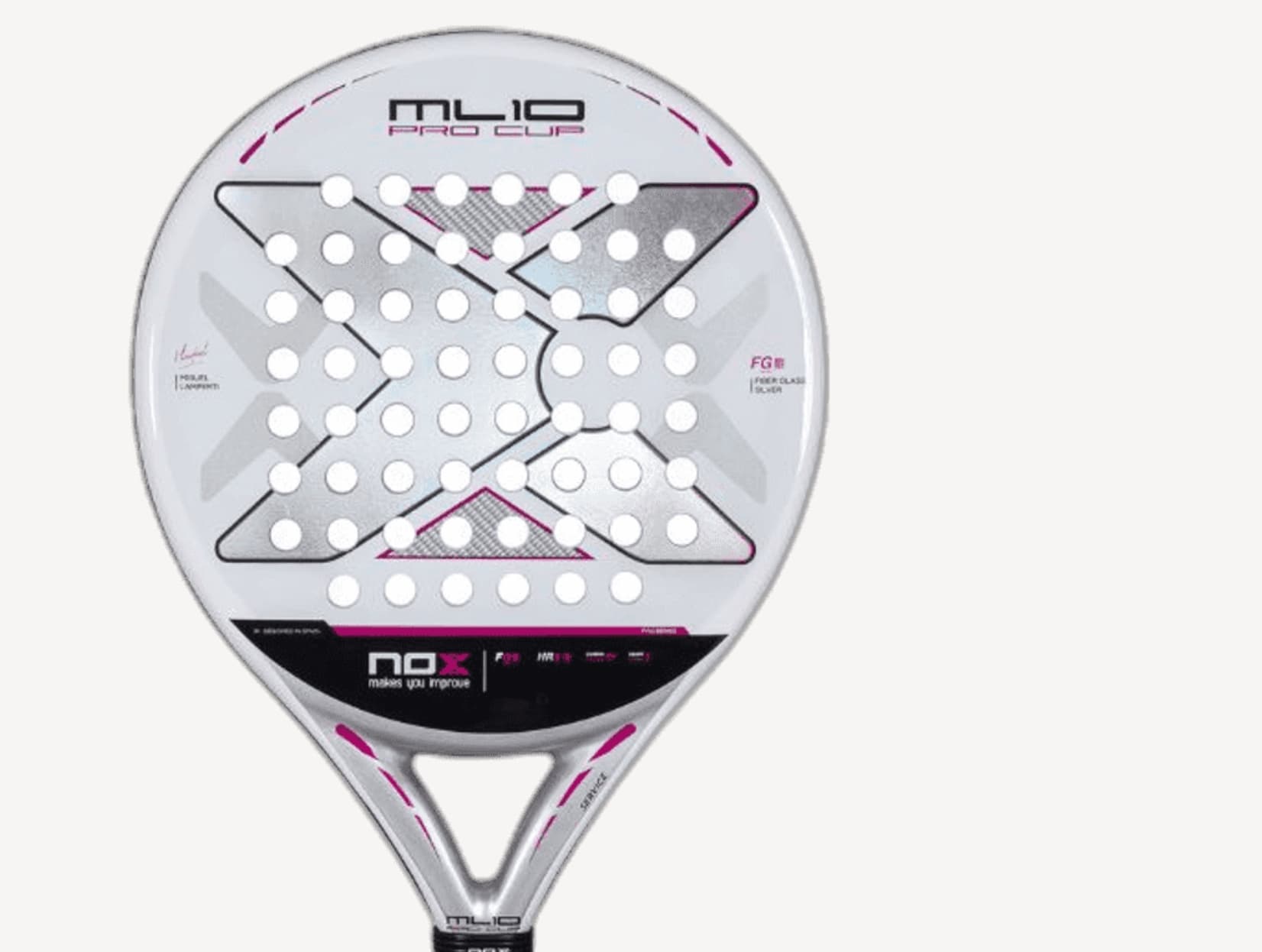
The Nox ML10 Pro Cup has quietly become one of the most bought rackets in padel, and it has held that spot for years. Designed with input from Miguel Lamperti, it favours control over raw power, wrapped in a round shape and a sub-£200 price tag that keeps tempting intermediate players away from cheaper, less capable frames.
Nox doesn't tinker much with the Pro Cup, and that's rather the point. The 2025 version keeps the same round head, low balance and HR3 core that made the racket popular in the first place. Rather than chasing trends, Nox leans on a formula that already works for a huge number of club players.
On paper the numbers are unremarkable. A round-shaped head, 360 to 375g weight range, 38mm thickness and a carbon frame paired with a Fiberglass Silver face. None of that screams excitement. What matters is how those parts behave together once the ball is actually in play.
That round shape is the whole story here. It shifts the sweet spot toward the centre of the face and makes it considerably larger than you'd find on a diamond or teardrop racket. Mishits that would sting on a power-focused frame barely register on the ML10 Pro Cup. For players still building consistency, that forgiveness matters more than an extra few kilometres an hour on a smash.
The balance sits low, with weight pulled back toward the handle rather than out towards the head. This is what gives the racket its reputation for manoeuvrability. Quick exchanges at the net feel unhurried, and there's enough time to adjust the face angle even when a volley arrives faster than expected. Defensive blocks at the net come off cleanly, without the wrist strain that heavier, head-heavy rackets can bring on.
Underfoot, or rather underhand, the impact feels softer than you might expect from a carbon-framed racket. The HR3 EVA core absorbs a good deal of shock at contact, so long defensive rallies don't leave your arm feeling battered by the end of a session. Some reviewers describe the touch as medium to medium-hard rather than genuinely soft, and that seems fair. There's enough feedback to judge shot quality, without the harshness that firmer, more aggressive frames can produce.
Where the ML10 Pro Cup shows its limits is power. This isn't a racket built to end points with a single smash. Players used to stiffer, diamond-shaped frames will notice the drop-off immediately when they try to overhit from the back of the court. Some aggressive hitters reject it outright for that reason, and that's a fair response if smashing is central to your game. The trade-off is deliberate. Nox built this racket around control and comfort, and power was never the priority.
Should you worry about that trade-off if you're an intermediate player working on consistency? Not really. Most players at that level lose more points through unforced errors than they gain from extra pace, and the ML10 Pro Cup is built precisely to reduce those errors.
The build quality holds up reasonably well too. The Smartstrap system lets you swap out the wrist strap when it wears down or needs a hygiene refresh, a small but genuinely useful touch that a lot of rivals still lack. Nox also builds in vibration dampening through the handle, which contributes to that arm-friendly feel during longer sessions. A handful of buyers have reported cracked faces after hard impacts, which is worth flagging, though it's not a pattern that dominates feedback across retailers.
Price varies a fair bit depending on which edition and retailer you land on, with UK stockists typically listing the standard Pro Cup Silver around £170. Given how consistently it appears near the top of best-seller lists across multiple shops, that price feels justified rather than inflated.
I'd stop short of calling it the most exciting racket in the Nox range. It isn't. What it offers instead is dependability, which is a rarer quality than it sounds in a market full of rackets chasing headline power figures.