Decathlon's carbon-faced hybrid takes on rackets twice its price
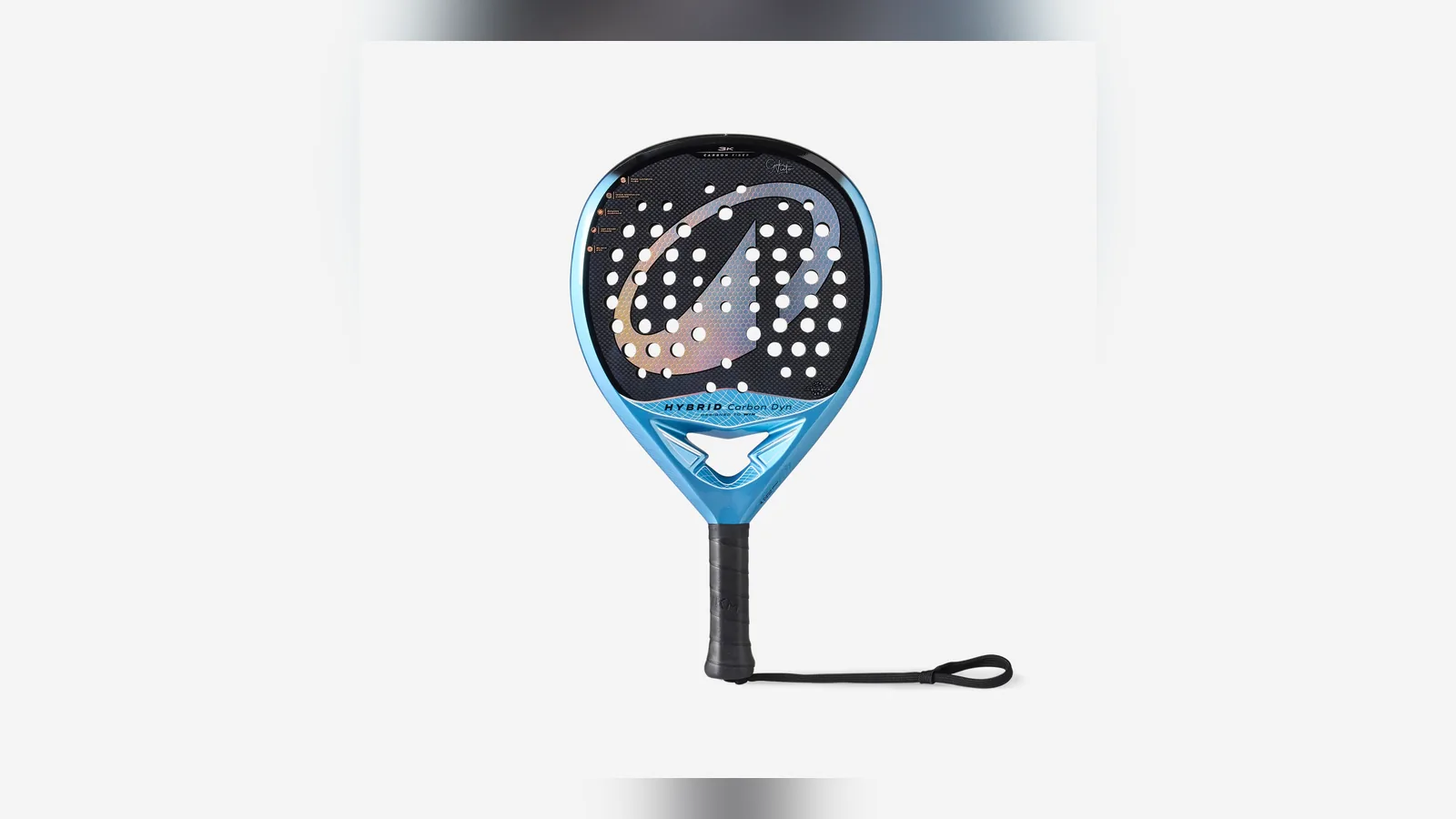
Kuikma's PR Hybrid Carbon sits in an odd spot for a sub-£110 racket. It carries a genuine 12K carbon face, a twin-tube carbon frame and Decathlon's own vibration-damping system, features you would normally expect on something costing twice as much. The question worth asking is whether the rest of the package earns that headline spec.
Kuikma is Decathlon's in-house padel brand, and it has quietly become one of the more credible names on UK courts. The Hybrid Carbon replaces the older 990 line, and it was co-developed with Spanish tour player Coki Nieto, whose name appears on the racket itself. It sits in the middle of Kuikma's current carbon range, between the more forgiving Control Carbon and the attacking Power Carbon.
Shape and build
The head shape is genuinely hybrid, a blend of the round profile favoured by defensive players and the pointed teardrop preferred by attackers. Weight comes in at 370g, plus or minus 5g, with an even balance measured at 260mm from the base of the handle. That places the mass close to your hand rather than stacked in the head, which changes how the racket behaves compared with a diamond-shaped power frame.
Build quality follows the same theme. Three layers of fibreglass sit behind a 12K carbon face, reinforced with what Kuikma calls high-modulus carbon. The frame uses a double tubular construction, with EVA foam packed inside to add rigidity without piling on weight. A rough, textured surface runs across the strings, there to help the ball grip on serves and topspin drives rather than skid off cleanly.
How it plays
The even balance is the single biggest factor in how this racket feels on court. Rather than loading weight into the head for maximum smash power, Kuikma has kept things closer to neutral. That makes the Hybrid Carbon quicker through defensive exchanges and easier to redirect at the net, at some cost to outright power on flat drives.
Players stepping up from a softer fibreglass beginner racket should notice the difference in feedback almost immediately. The 12K carbon face responds more sharply than fibreglass, and shots come off with more pace for the same swing effort. It rewards a proper, committed stroke rather than a half-hearted poke at the ball.
Where does it fall short? Anyone chasing genuine smash power will find the even balance holds them back slightly compared with a diamond-shaped racket built purely for attack. This is not a criticism so much as a design choice. Kuikma sells a Power Carbon model in the same range for players who want that extra weight up top, and the Hybrid Carbon was never trying to compete with it on raw force.
Control and the sweet spot
This is where the hybrid design earns its keep. The medium-density black EVA core produces a controlled, slightly softened response rather than a hard crack, which makes placement noticeably easier than on stiffer, harder-cored rackets. Decathlon's own customer reviews back this up. The Hybrid Carbon holds a 4.7 out of 5 rating from 137 reviews on Decathlon's site, with owners frequently describing it as forgiving for a carbon racket, a phrase that rarely applies to rackets in this price bracket.
The hybrid head shape also spreads the effective sweet spot wider than a teardrop would allow. Mishits still lose pace, as they do on any racket, but the drop-off feels more gradual than on a narrower, more head-heavy frame.
Comfort
Comfort is arguably the strongest single element of this racket. Kuikma fits a Shock Block System into the handle, an elastomer insert designed to cut vibration on impact. Independent lab testing by Testea Padel, commissioned by Decathlon, recorded vibration reductions of up to 38 percent using this system. Combined with the medium EVA core and the foam-packed frame, off-centre hits feel notably softer than the carbon face and stiff frame might suggest.
Players managing elbow or wrist niggles often gravitate towards softer, more forgiving cores, and while Kuikma does not market this specifically as an arm-friendly racket, the ingredients for that role are clearly present.
Spin and manoeuvrability
The rough surface finish does what it promises. Serves and topspin drives grip the ball noticeably better than on smoother-faced rackets, giving players more shape and bite on their shots. At 370g with an even balance, the racket handles quickly enough at the net for fast volley exchanges without feeling flimsy in defence.
Is 370g heavy for a hybrid racket? Not particularly. Adult padel rackets typically sit between 350g and 390g, so this lands comfortably in the middle of that range rather than at either extreme. Players used to a lighter frame may notice the difference in the first few sessions, but most adapt within a couple of matches.
The handle itself deserves a mention too. Kuikma has kept the grip fairly standard in thickness, which suits players moving between rackets without needing to relearn their hold. A wrist-strap fastening system allows the strap to be removed and replaced, a small but useful touch for anyone who prefers to wash or swap it out.
Value
At £109.99, the Hybrid Carbon undercuts most branded rivals offering comparable carbon construction. A genuine 12K carbon face, a carbon frame, a proven vibration-damping system and a two-year warranty rarely come together at this price point. Decathlon's product page describes it as suited to advanced players, which slightly oversells how demanding the racket actually is. The even balance and medium EVA core make it considerably more accessible than that label suggests, and it works just as well as a step-up racket for a confident improver as it does a budget second racket for a more advanced player.