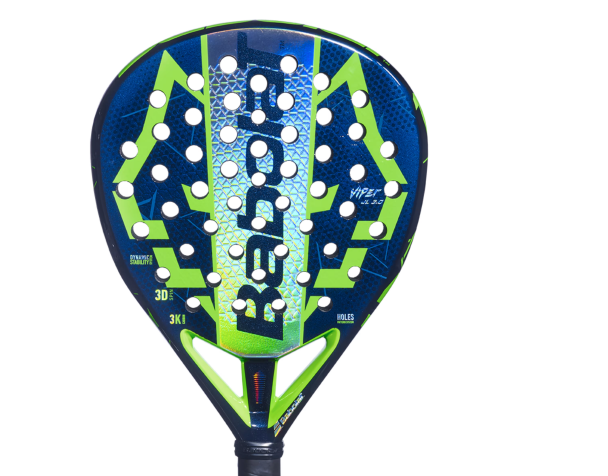
The Babolat Viper Juan Lebrón 3.0 does not try to be reasonable. Built around the diamond head and hard EVA core that carried Lebrón through four years as world number one on the professional tour, it exists for one job: making the ball disappear on the smash. Comfort and forgiveness were never part of the brief, and this racket makes no apology for that.
There is no gentle way to introduce this racket. Pick it up and the weight sits high, right where Babolat wants it. The diamond shape pushes mass toward the top of the frame, and you feel that the moment you start swinging through a shadow shot. This is not a racket you steer. It is one you commit to.
Some players may notice the head feels slower to bring round on quick net exchanges than a round or teardrop shape would allow. That is the trade being made here. Babolat has built a frame for players who live above shoulder height, not one that apologises for its intentions at the net.
Juan Lebrón himself is the reason this racket exists in its current form. Nicknamed El Lobo, he held the world number one ranking for four consecutive years between 2019 and 2022, and few players in padel hit the ball with quite the same violence off the smash. Babolat's signature line is built to chase that reputation rather than soften it.
Smashing: where the reputation is earned
Smashing is where the Viper Juan Lebrón 3.0 stops being demanding and starts being genuinely exciting. The carbon face gives a firm, almost dry response on contact, and the Dynamic Stability System, a reinforced bridge built into the throat of the frame, keeps the head from twisting when you really commit to a fast overhead. Time the swing and the ball leaves with the kind of pace that ends points outright.
In testing this style of racket against slower, more control-oriented frames, the difference on kick smashes is obvious. The stiffer face grips the ball fractionally longer, which helps it jump awkwardly off the bounce rather than skidding through flat. Against a good blocker that half second of extra bite can be the difference between a rally continuing and it finishing there and then.
Bandejas and víboras benefit from the same characteristics, though they ask more of the player. You need early preparation and a full swing to get the frame working properly. Rush the shot, or meet it late, and the head-heavy balance turns from asset to liability rather quickly. There is little margin here for a half-hearted swing.
Defence: the price of all that power
Defence is where this racket asks the most searching questions. The sweet spot sits high on the face, closer to the upper section than the centre, which is typical of power-focused diamond frames but far from forgiving. Blocks played off centre feel dead rather than lively, and the ball often falls short when contact is not clean.
Players used to a round or teardrop shape, with a lower and larger sweet spot, will feel this immediately. Passive blocking, in particular, does not suit the Viper Juan Lebrón 3.0. It rewards players who take the ball early and with intent, and punishes hesitation at the net rather than compensating for it.
Is that a flaw? Not really, more an honest reflection of what the racket is for. Babolat built this as an attacking weapon first, and everything about the geometry supports that single ambition rather than trying to do a bit of everything reasonably well.
Build, feel and what it costs
Underfoot, or rather under-hand, the build quality feels appropriately premium. The carbon surface has a slightly textured finish that helps grip the ball on slice and spin shots, and the frame itself feels dense rather than hollow when tapped. There is a vibration-damping system built into the core, elastomers designed to soak up some of the shock at the point of impact, though players with existing arm or elbow issues will still find this a stiffer, less sympathetic racket than Babolat's own Soft version of the same frame.
Break-in is minimal. This is not a racket that softens with use in the way some fibreglass models do. What you feel in the first session on court is largely what you get for the life of the frame, which suits players who know exactly what they want from a paddle before they buy one, and less so those hoping the racket will mellow with time.
At around 370 grams, this sits toward the heavier end of the diamond category, and the balance is unmistakably head-heavy rather than the more neutral setup found on some rival power frames. Fitness and technique both matter more here than they would on a forgiving, round-shaped racket aimed at club-level all-rounders. Anyone coming back from a wrist or shoulder niggle should think twice before reaching for this one.
Pricing places it among the more expensive rackets on the market, in line with other flagship signature models from the major brands. That is not unusual for a top-tier player edition, but it does mean the Viper Juan Lebrón 3.0 is a considered purchase rather than an impulse buy, particularly for anyone still building the technical foundation needed to use it properly.
Grip feel is solid rather than showy. The handle itself does not stand out in either direction, and most players will want to add their own overgrip fairly quickly, which is standard practice at this level rather than any particular shortcoming of the racket.
Whether this racket suits you comes down almost entirely to where you stand on court and how you get there. Players who commit fully to their swings, prepare early and enjoy finishing points at the net will find a great deal to like here. Those who spend more time defending, blocking and resetting rallies are likely to find the experience frustrating rather than rewarding, no matter how good their technique.